 Winton Eliott
Every day, you do tons of things—some helpful, some… well, not so great—and half the time you don’t even notice. But what if you could decode why you do what you do? That’s where the ABC model comes in: Antecedent, Behavior, Consequence. It’s like having cheat codes for your own brain. Psychologists, teachers, coaches—everyone uses it because it works. Whether you’re trying to figure out why your little brother melts down over nothing, why a team slacks off, or why you keep doom-scrolling at 1 AM, the ABC model helps you break the cycle and take back control.
What Is the ABC Model?
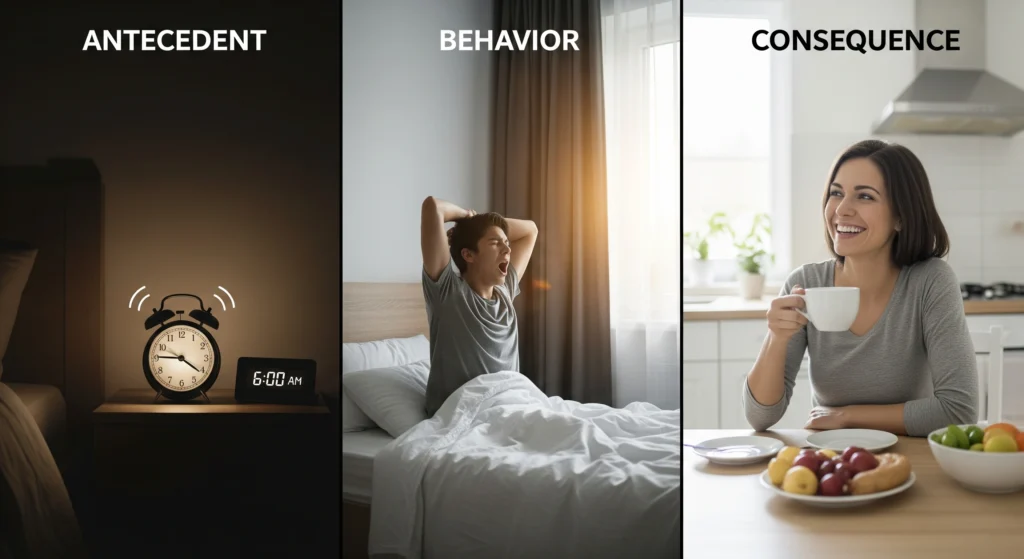
The ABC model is basically the “behavior breakdown” cheat sheet. It says every action you take has three parts:
- Antecedent: What sets you off (like your sibling breathing too loudly).
- Behavior: What you actually do (eye roll, sigh, dramatic exit).
- Consequence: What happens after—and whether you’ll do it again.
Built on ABA science, this model helps experts (and you!) figure out why people act the way they do and how to change it. Studies even show it works about 85% of the time—way better than guessing or blaming everything on “teen hormones.”
Breaking Down the Components
Antecedents: The Invisible Triggers
Antecedents are the sneaky “before moments” that set you up to act a certain way—like being tired, hungry, stressed, or just annoyed because it’s Monday. They can be anything: the people around you, your emotions, even the time of day. Picture someone always late on Mondays—yeah, the real culprit might be Sunday-night stress wrecking their sleep. Studies show that when you figure out these triggers, behavior change becomes way easier—like 60% more effective!
Behavior: The Observable Action
This part is simple: it’s what you actually do. But it has to be something people can see or hear—not vague stuff like “being rude.” That needs to be broken down into specifics like interrupting, yelling, or storming out dramatically (we’ve all been there). The goal? Describe it so clearly that two strangers would agree exactly on what happened. No guesswork, no “I think he meant…”
Consequences: The Reinforcement Factor
Consequences are whatever happens right after your behavior—and they decide whether you’ll do it again. Rewards, praise, getting out of chores? Those make behaviors stronger. Losing privileges or getting extra work? Not so much. The main trick: consequences have to be fast. Research shows that if you wait even a few seconds, the impact drops like 50%. Basically, your brain has the attention span of a goldfish when learning from consequences.
Practical Applications of the ABC Model
In the Workplace
Companies use the ABC model to fix stuff like missed deadlines and team stress. For example, if a sales team keeps procrastinating, the real trigger might be confusing instructions, not laziness. Fix the trigger (clear goals), reward early work, and boom—behavior changes. Businesses that use ABC properly see performance jump by almost 40%. That’s like going from “meh” to “crushing it” in a few months.
In Education
Teachers love ABC because it shows what’s really going on. A kid acting out might not be “trying to be annoying”—they might just be confused and avoiding work. When teachers fix the trigger (help the student) and reinforce positive behaviors, classroom chaos drops fast—sometimes by 65% in a month. Basically, ABC is like giving teachers X-ray vision for behavior.
In Parenting and Personal Development
Parents can finally solve tantrums without turning into exhausted zombies. A kid refusing bedtime might be scared of missing out, so they cry until parents cave—reinforcing the behavior. Change the trigger (give attention earlier) and the consequence (stay consistent), and things improve. Research even shows parents feel 70% more confident with these tools.
And for you? ABC can help you break habits like stress-eating, doom-scrolling, or procrastination. Once you spot your patterns, you can swap them for healthier ones—without feeling like your life is one big self-improvement lecture.
How to Conduct an ABC Analysis
Implementing the ABC model effectively requires systematic observation and analysis. Here’s a step-by-step approach:
Step 1: Identify and Define the Target Behavior
Get super specific. Don’t say “she has a bad attitude”—that means nothing. Say “she rolls her eyes every time someone reminds her about homework.” Think of it like describing a scene in a movie so clearly that anyone watching would agree on what happened.
Step 2: Observe and Record
Make a simple ABC chart—three columns, nothing fancy. For a few days, write down every time the behavior happens: what happened right before, what they did, and what happened right after. You’re basically being a detective here. Look for clues—same time of day? Same person around? Same situation?
Step 3: Analyze the Patterns
Now put on your “behavior scientist” goggles. Check your notes and see what keeps popping up. Maybe your little brother acts out every time he’s asked to clean his room. Hmm… escape behavior much? People usually act out for attention, to avoid something, to get something, or because it just feels good in the moment.
Step 4: Develop an Intervention Strategy
Once you know the real “why,” you can create a plan. Maybe you change the trigger, teach a better way to handle the situation, or switch up the consequences. Think of it like hacking the system—you’re making the healthy behavior the easiest one to choose.
Step 5: Implement and Monitor
Now try your plan and keep tracking what happens. Behavior change is not magic—it’s more like training a stubborn puppy. It takes consistency. Usually you start seeing real improvements in two to four weeks, but only if you stick with it like a boss.
Common Mistakes to Avoid
A lot of people mess up ABC analysis because they only look at consequences and ignore triggers—kind of like treating a fever but never checking what caused it. Another big mistake? Being inconsistent. If you only react sometimes, the brain gets confused and the behavior sticks around longer.
People also accidentally reward bad behavior—yes, even yelling can be a “reward” if someone just wants attention. And don’t forget to actually praise the good stuff; catching someone doing something right is just as important.
And please don’t expect instant results. Behavior change takes patience—usually at least three weeks. Think of it like trying to get fit: you don’t get abs after two sit-ups.
The Science Behind the ABC Model
The ABC model isn’t woo-woo—it’s backed by decades of research. B.F. Skinner showed that our actions are shaped by what happens after them. Modern brain scans prove it: your reward centers literally light up when something good happens, making that behavior easier to repeat. Meanwhile your amygdala jumps into action to avoid bad consequences—your brain’s built-in “danger detector.”
One huge review of 200+ studies found that ABC-based strategies work across tons of situations—especially when you tackle all three parts, not just the consequences. In other words: the science is solid, and your brain is totally programmable with the right tools.
Conclusion: Taking Action with the ABC Model
The ABC model—Antecedent, Behavior, Consequence—is basically your personal cheat code for understanding why people (including you!) do what they do. When you figure out what triggers a behavior, what the behavior actually looks like, and what rewards it afterward, you can finally change things that once felt stuck.
Whether it’s school drama, family chaos, annoying habits, or your own procrastination monster, the ABC model gives you a clear, science-backed way to fix it. Just don’t rely on consequences alone—look at the whole pattern.