
 Winton Eliott
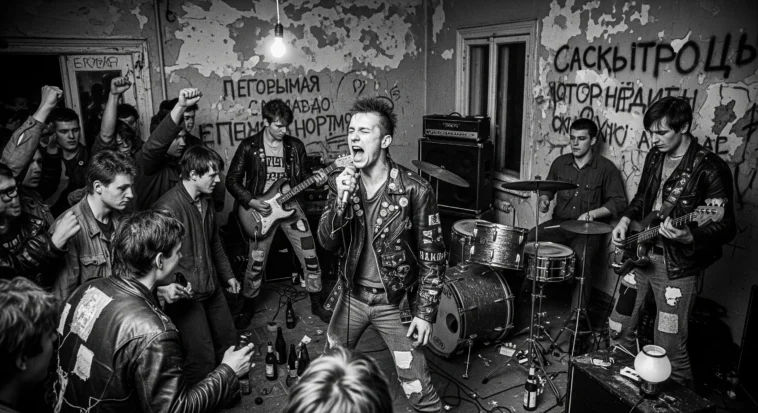
In the middle of one of the strictest governments in history, punk music exploded in the USSR — and it wasn’t just about loud guitars or ripped jeans.
It was rebellion with a beat.
For teens crammed into gray Soviet apartments, blasting punk was like yelling, “We won’t be silenced!”
This underground scene became more than music — it was cultural warfare, proof that songs could shake authority and spark freedom.
In the end, those raw chords helped crack the system that once felt unbreakable.
The Seeds of Rebellion: Understanding Soviet Cultural Control
In the Soviet Union, art wasn’t just art — it was a weapon for the state.
Every song, painting, or performance had to fit communist ideals, and anything too “Western” or rebellious was banned.
Rock and punk? Totally outlawed, labeled as dangerous poison for young minds.
Imagine living in a world where the only music you’re allowed to hear is government-approved propaganda songs.
That’s the cultural vacuum Soviet teens grew up in.
But instead of staying silent, they filled that silence with their own raw, rebellious sounds.
And breaking the rules wasn’t just risky — it could cost you everything. Musicians caught outside the system were watched, silenced, even jailed. Creating unapproved music wasn’t just art; it was an act of defiance.
- Read also: Soviet Psychic Warfare Programs: The Cold War’s Secret Battle
- Read also: Unveiling the Legends: 9 Iconic Russian Historical Figures
The Birth of Soviet Punk: Early Pioneers and Underground Networks
Soviet punk kicked off in 1979 with AU (Automatic Satisfiers), led by Andrei “Svin” Panov in Leningrad.
Soon after came wild acts like Vova Blue & The Brothers of the Mind, a band so underground their hometown wasn’t even on maps — way deeper than New York’s CBGB scene ever was.
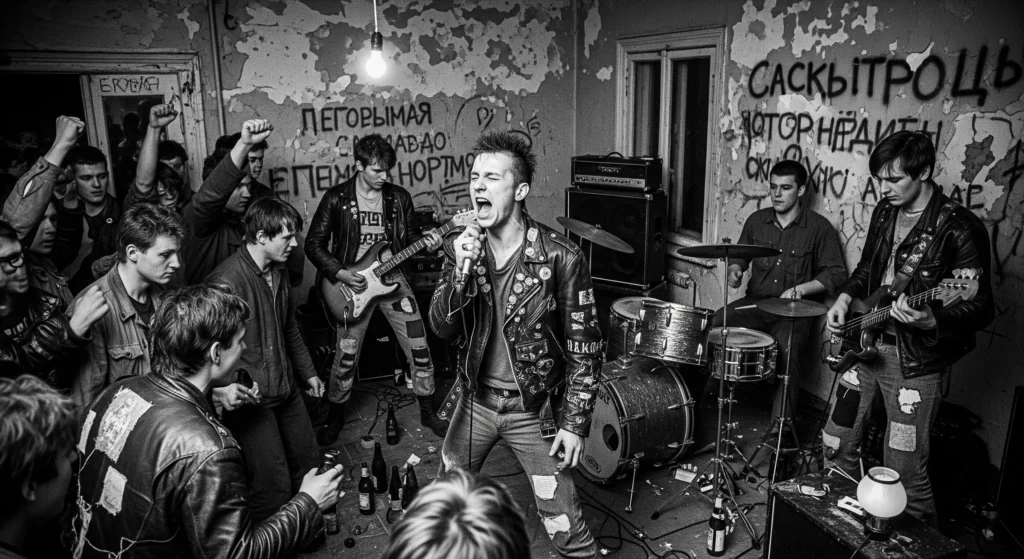
They performed in basements, abandoned factories, and cramped apartments – where the bands played songs about freedom — corruption — life under a system that wanted them to be silent.
The use of simple instruments and DIY methods was evident in the recordings, which were purely hand-crafted. There was no fancy equipment used.
Key Characteristics of Soviet Punk Music
Lyrical Themes:
- Political dissent and criticism of government
- Individual freedom and personal expression
- Social problems ignored by state media
- Existential questions about life under communism
- Western cultural influences and values
Musical Style:
- Raw, aggressive sound reflecting anger and frustration
- DIY approach due to limited access to professional equipment
- Fusion of Western punk influences with Russian folk traditions
- Experimental approaches born from necessity
Performance Venues:
- Private apartments and basements
- Abandoned industrial buildings
- Secret underground clubs
- University dormitories
- Forest clearings outside cities
Magnitizdat: The Underground Distribution Network
Magnitizdat was basically the Soviet version of bootleg mixtapes.
Since punk couldn’t be sold in stores, kids copied songs onto cassette tapes and passed them around like secret treasure.
It worked just like samizdat (illegal books), but for music.
How it worked:
- Bands recorded rough tracks in bedrooms or basements.
- Fans with tape recorders copied them — each copy sounding fuzzier than the last.
- Tapes traveled hand-to-hand through trusted friends, spreading across the USSR like wildfire.
- Even tiny towns ended up blasting music the government tried to erase.
For Soviet teens, getting a scratched-up punk cassette felt like discovering another world.
Magnitizdat wasn’t just music-sharing — it was building hidden communities, where every tape carried not just songs but ideas of freedom and rebellion.
Iconic Soviet Punk Bands and Their Impact
Kino and Viktor Tsoi
In the Soviet Union of the 1980s, teenager would often find themselves surrounded by gray apartments and propaganda overload, with only state-approved fluff to communicate anything.
The band Kino, led by Viktor Tsoi, is now in attendance.
It was as if their music was opening like a hidden door.
Tsoi’ lyrical style was reminiscent of Joy Division or The Cure, but its lyrics were so passionate that they resonated with Soviet children who felt disenchanted by the system.
However many had forgotten about them during this time. Not only was he the embodiment of rock music, but a generation that craved authenticity.
His impact on the industry is undeniable. Many adolescents felt understood for the first time after listening to Kino on a scratchy cassette.’
Grazhdanskaya Oborona (Civil Defense)
Now, if Kino gave kids hope, Grazhdanskaya Oborona (or “GrOb” as fans called them) threw gasoline on the fire.
Led by Yegor Letov — think of him as the ultimate Soviet punk rebel — their songs weren’t subtle at all.
They screamed straight at the government, raw and furious.
Letov wasn’t trying to make nice with the system; he wanted to tear it down.
And somehow, even from the frozen corners of Siberia, his music spread like wildfire, shaking up kids all across Russia.
The Siberian Scene
Here’s the wildest part: the beating heart of Soviet punk wasn’t Moscow or Leningrad — it was Siberia.
Yeah, the same Siberia people usually associate with prisons and frozen wastelands.
In those concrete cities built by Gulag labor, far from the watchful eye of the Kremlin, bands like Civil Defense, Survival Instruction, and BOMZh could actually push boundaries.
The isolation gave them freedom — no cultural police breathing down their necks every second.
Out there, punk wasn’t just a music style. It was survival, rebellion, and truth screamed into the cold night.
Methods of Resistance and Subversion
Coded Language and Metaphor
Punks couldn’t just scream “Down with the government!” without ending up in jail, so they got clever.
They hid political messages in songs about love, nature, or even everyday life.
Teens knew the secret meanings — like a code only they could crack.
Mobile Performances
Picture this: a band sets up in a basement, plays two songs, and then — poof — they’re gone before the KGB shows up.
By the mid-80s, gigs were nomadic, moving from one hidden spot to another, like rebels on the run.
DIY Recording and Production
With no fancy studios, they made their own.
Musicians recorded on whatever junk equipment they could find, then decorated tapes with handmade artwork that felt more personal — and honestly cooler — than anything sold in official stores.
Underground Venues and Safe Houses
The scene thrived because people risked a lot to help.
Apartment owners turned their living rooms into secret clubs.
Students smuggled shows into dorms. Workers unlocked abandoned factories at night.
Artists built wild, temporary venues. It was a whole shadow world built by trust.
Community Building
This wasn’t just music; it was family. Punk kids had each other’s backs.
They shared tapes, protested together, and gave each other safe spaces to breathe in a country that tried to choke them.
It wasn’t just about sound — it was about survival.
Government Response and Persecution
Surveillance and Infiltration
The Soviet authorities weren’t stupid — they knew punk was dangerous because it gave young people ideas.
So, they planted spies in the crowd. Imagine jamming in a basement and wondering if the dude nodding along in the corner is actually KGB. That was real life.
Arrests and Imprisonment
If you got caught, you didn’t just get a slap on the wrist.
Musicians were hauled off to jail for “hooliganism” — which basically meant being young and loud. Some were sent to brutal labor camps for singing songs the government didn’t like.
Censorship and Suppression
The crackdown was intense. Police raided secret shows, snatched up tapes, and even read people’s mail to stop the spread of punk.
Your entire music collection could vanish in a single raid. Imagine losing every playlist you’ve ever made overnight.
Psychological Warfare
The scariest part? The mind games.
Authorities threatened musicians’ families, ruined their careers, and made sure they were treated like outcasts.
Some were even locked in psychiatric hospitals and told their passion for music was a “mental illness.”
The Cultural Impact of Soviet Punk
Youth Consciousness and Identity
By the 1980s, Soviet teens were done with gray walls, boring speeches, and being told what to think.
Punk hit like a lightning bolt—it gave them an identity the government couldn’t control.
Suddenly, kids weren’t just “Soviet citizens,” they were rebels with ripped jeans, scribbled lyrics, and dreams of tearing down the system.
Punk told them, “Yeah, it’s not just you. This place really is messed up.”
Alternative Values and Lifestyle
Punk was a complete reverse. The group did not surrender and instead shouted, “Be yourself, even if it means getting hurt.”
Punks challenged everything instead.
Their choices were to swap gray uniforms for leather jackets, Soviet slogans as Western anthems and political correctness as honest honesty.
Network of Resistance
Here’s the wild part—punk wasn’t just about music.
The same underground tape-trading networks that spread songs also spread protest ideas, secret meetups, and even political manifestos.
Imagine your favorite playlist also doubling as a guidebook for rebellion.
That’s how punk became the wiring of a movement.
Artistic Innovation
They invented everything because they had no resources.
The Soviet punks transformed faulty amps, home-made guitars and scratchy tape recorders into instruments for expression.
Artists worldwide were inspired by the Russian spirit of creating scrappy and do-it-yourself.
Punk demonstrated that you didn’t have to be fancy to change culture. Fire and noise were all that was required.
Legacy and Lasting Influence
The echoes of Soviet punk are still loud today — its noise didn’t die with the regime; it changed the soundtrack of resistance.
Modern Russian Music
Today’s Russian artists still steal tricks from the punk playbook: blunt lyrics, risky politics, and that DIY attitude.
Think of how a new band samples an old punk riff — it’s like a secret handshake across generations.
Global Influence
The Soviet punk story traveled far.
Musicians and activists worldwide see it as proof that art can punch above its weight — even under the strictest rules, a few chords and honest words can spark change.
Historical Documentation
Scholars and documentarians keep digging into the scene because it’s a perfect case of grassroots rebellion.
Those scratched tapes and secret gig flyers are now priceless papers for understanding how people resist.
Cultural Memory
Across former Soviet countries, punk isn’t just old music — it’s part of collective memory.
People still celebrate it as a moment when culture helped push toward freedom, like a shared story everyone remembers telling.
- Read also: Russian Revolution Facts: Historical Context and Significance
- Read also: How the Berlin Wall Fell: History’s Most Symbolic Moment
Conclusion: The Enduring Power of Punk Resistance
The rise of punk in the USSR wasn’t just kids making noise — it was one of the boldest acts of cultural rebellion in history.
Imagine a handful of scrappy musicians with homemade guitars going up against one of the world’s most controlling governments… and actually shaking it.
Through guts, creativity, and pure refusal to shut up, Soviet punks proved something huge: no regime can fully cage human expression.
Their songs didn’t just echo in basements — they helped fuel the cracks that brought down walls, both literal and political.
The lesson? Sometimes the sharpest weapon against tyranny isn’t a bullet — it’s a power chord, played loud enough to wake up a generation.