
 Harden Elkington
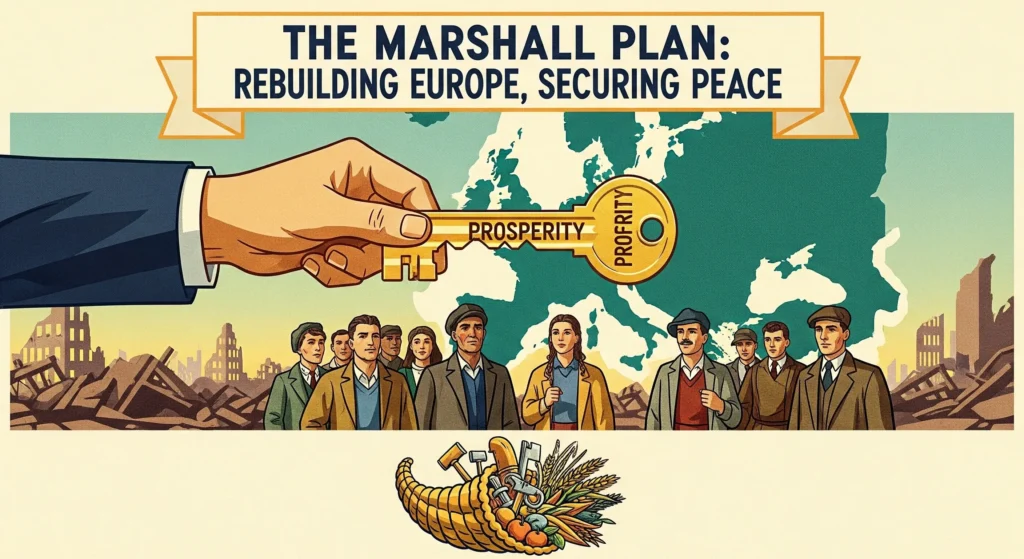
The wreckage of World War II left Europe starving, broke, and in pieces. Entire cities were rubble, jobs were gone, and people had no homes.
But here’s the crazy part — within just a few years, Western Europe was not only back on its feet but booming. The secret? The Marshall Plan.
Named after U.S. Secretary of State George C. Marshall, this wasn’t just about handing out money. It rebuilt cities, rebooted economies, and even changed how countries worked together.
The Devastating Context: Europe After World War II
Economic Destruction on an Unprecedented Scale
By 1945, Europe was wrecked. Factories bombed out, farms ruined, bridges gone, and whole cities turned to dust.
Imagine trying to do homework without a desk, books, or even lights — that’s how Europe’s economy felt.
Industrial production was cut in half, farms were producing a quarter less food, and millions had no homes. Money was basically worthless, so people turned to black markets just to survive.
The Looming Threat of Soviet Expansion
And it wasn’t just about food or money — politics was on the line too. With so much desperation, communism started looking pretty attractive to struggling people.
The Soviet Union was already spreading its influence across Eastern Europe, and Western Europe was at risk of following.
For the U.S., helping Europe recover wasn’t just charity — it was strategy to stop the spread of Soviet power.
The Genesis of the Marshall Plan
George Marshall’s Vision
On June 5, 1947, U.S. Secretary of State George C. Marshall gave a graduation speech at Harvard that basically changed the world.
He argued that Europe didn’t just need a few quick fixes or handouts — it needed a big, united plan to rebuild. And here’s what made his idea groundbreaking:
- He offered help to all European countries — even those America had just fought against.
- He pushed European nations to work together, not separately, on their recovery.
- He focused on rebuilding for the long run instead of just handing out emergency supplies.
- He tied the aid to democracy and free-market reforms — no dictatorship shortcuts.
From Concept to Legislation
Getting this plan through the U.S. Congress wasn’t easy. A lot of Americans were tired of war and didn’t want to spend billions fixing someone else’s problems.
But a few key things flipped the script:
- The Truman Doctrine: President Truman had already promised to fight communism, so helping Europe fit the strategy.
- Soviet Rejection: The USSR refused the offer and forced Eastern Europe to do the same — making it clear this was a West vs. East moment.
- Bipartisan Support: A Republican senator, Arthur Vandenberg, broke party lines and backed the plan, which helped push it through Congress.
How the Marshall Plan Operated
Financial Scale and Distribution
From 1948 to 1951, the U.S. poured $13.3 billion into Europe — that’s like $150 billion today. This wasn’t pocket change; it was one of the biggest financial rescue missions in history.
The money wasn’t handed out randomly either — it was carefully planned. Here’s who got the biggest chunks:
- United Kingdom: $3.2 billion
- France: $2.7 billion
- West Germany: $1.4 billion
- Italy: $1.2 billion
- Netherlands: $1.1 billion
Key Mechanisms and Requirements
What made the Marshall Plan genius wasn’t just the money — it was how the money was used.
- The OEEC: European countries had to join the Organization for European Economic Cooperation to coordinate the plan.
- Counterpart Funds: For every U.S. dollar they got, countries had to put the same amount of their own currency into special accounts.
- Technical Assistance: America didn’t just send cash — it sent experts. Think engineers teaching new farming methods, or business pros showing factories how to modernize.
- Trade Liberalization: Countries had to lower trade barriers and make their money more flexible, so buying and selling across borders became easier.
The Implementation Strategy
Sector-Specific Approaches
The Marshall Plan rebuilt Europe by fixing everything at once — kind of like rebuilding a broken phone, a bike, and your homework setup all in the same weekend.
Here’s how they did it:
Industrial Reconstruction
- Modernized steel, coal, and factories so they worked faster and smarter.
- Brought in new tech and production methods — think upgrading from an old flip phone to a smartphone.
- Repaired railways and ports so goods could actually move.
- Restored power grids so factories and homes had electricity again.
Agricultural Recovery
- Sent fertilizers, seeds, and farm machines so fields could grow food again.
- Taught modern farming methods — like switching from hand-watering to a drip system that saves time.
- Fixed food supply chains so crops reached people instead of rotting.
- Backed land reforms in some places to make farming fairer and more productive.
Currency Stabilization
- Helped countries set steady exchange rates so money wasn’t completely unpredictable.
- Supported monetary reforms and pushed for modern banking systems.
- Pushed governments toward fiscal responsibility — balancing budgets so the economy wouldn’t crash again.
Administrative Excellence
It wasn’t just about giving money — it was about doing it well. The Economic Cooperation Administration (ECA), led by Paul Hoffman, ran tight operations:
- Recipient countries sent regular progress reports.
- Officials did on-site inspections and audits.
- There were clear performance benchmarks and goals.
- Aid could be adjusted based on real results, not just promises.
Remarkable Results and Outcomes
Economic Recovery Statistics
The Marshall Plan didn’t just work — it smashed expectations. Picture a country that was starving and exhausted in 1947, and by 1951 it’s suddenly buzzing with life again.
Here’s the scoreboard:
- Industrial production shot up 64% above pre-war levels. Imagine your grades going from barely passing to straight A+ in just four years.
- Farms weren’t lagging either — agriculture grew 27%. Fields that once couldn’t feed families were now producing food for millions.
- Steel? It doubled. That meant bridges, buildings, cars — all got back on track.
- Coal production jumped 50%, fueling everything from trains to factories.
- Western Europe’s GNP grew 32%, basically meaning the whole region’s “paycheck” got way fatter.
Living Standards Improvement
And this wasn’t just numbers on paper — people felt it:
- Real wages climbed about 40%, so families finally had money for more than just survival.
- Unemployment plummeted. Suddenly, dads and moms who’d lost everything had steady work again.
- Stores filled with consumer goods. Think fridges, radios, clothes — stuff you take for granted today but felt like luxuries back then.
- Housing construction boomed. Entire neighborhoods rose from the ashes.
Structural Transformations
But here’s the real magic: it wasn’t just about recovery, it was about transformation.
- Modernization of Industry: European companies ditched clunky old methods and copied American-style production — think moving from rusty bikes to shiny Teslas.
- Financial System Development: The plan helped set up real banking systems, capital markets, and institutions that could keep economies stable long-term.
- Trade Integration: By pushing countries to cooperate and drop trade barriers, the Marshall Plan planted the seeds of what later grew into the European Union.
Criticisms and Limitations
Historical Debates
Okay, so here’s the thing: the Marshall Plan wasn’t some flawless superhero story. Historians still argue about its real motives.
- Self-Interest vs. Altruism: By rebuilding Europe, the U.S. created new customers for its goods and made sure communism didn’t spread like wildfire.
- Exclusion of Eastern Europe: The plan only covered Western Europe. Countries under Soviet control were shut out, which basically drew a bold line across the map — West vs. East.
- Dependency Concerns: Critics also wonder if Europe leaned too hard on American money. Did the aid spark independence, or did it make Europe too comfortable relying on Uncle Sam?
Measurement Challenges
And here’s another twist: economists can’t even fully agree on how much credit the Marshall Plan deserves.
- Maybe Europe’s recovery was partly a natural rebound — like how a broken bone heals over time.
- Some countries already had strong industrial foundations, so they might’ve bounced back faster anyway.
- Domestic policy reforms (local governments making smart moves) mattered a lot too.
- Plus, the late 1940s and early 1950s were riding on global economic growth trends, which boosted everyone, not just Europe.
Conclusion: The Marshall Plan’s Lasting Legacy
The Marshall Plan wasn’t just about throwing money at a broken Europe — it was about rebuilding hope, trust, and teamwork.
In just four years, countries that were literally in rubble turned into thriving economies and strong allies.
What made it work? It wasn’t just the cash. It was the mix of money, know-how, and rules that pushed nations to cooperate instead of compete.
Think of it like a group project where everyone had to actually share notes if they wanted to pass — and it worked so well it set the stage for the European Union.