 Harden Elkington
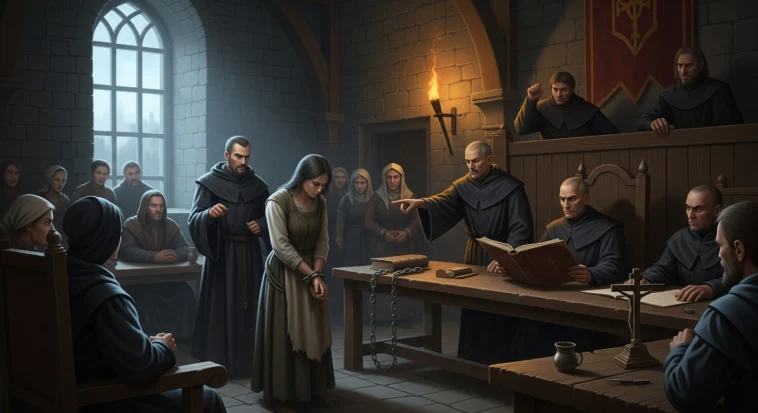
The flickering torchlight and whispered accusations weren’t rare scenes—they were terrifyingly normal.
In medieval and early modern Europe, something as small as talking to yourself or arguing with a neighbor could get you labeled a witch.
Fear ruled the day, logic took a vacation, and ordinary people paid the price.
The witch trials became one of history’s darkest moments, driven by panic, superstition, and the need to blame someone when things went wrong.

Understanding the Medieval Witch Trials Phenomenon
When we say “medieval witch trials,” we’re really talking about a long, messy stretch from the 1300s to the 1700s.
And here’s the plot twist: they didn’t peak in the Middle Ages like movies suggest.
The worst part came later—between 1450 and 1750—when Europe was changing fast because of religion, science, and politics.
Around 40,000 to 60,000 people were executed, and many more were tortured or exiled.
Basically, during a time when people were supposed to be getting smarter, fear took over—and thousands paid with their lives.
The Origins: How Witch-Hunting Began
Religious and Theological Foundations
At first, the Church wasn’t freaking out about folk magic—village healers and charms were mostly tolerated. Then things took a dark turn.
By the 1200s, church leaders started saying witches weren’t just quirky or superstitious—they were working for the Devil. Big yikes.
The real match-to-the-gasoline moment came in 1487 with a book called Malleus Maleficarum (“The Hammer of Witches”).
Think of it as a terrible instruction manual.
It explained how to spot witches, torture confessions out of them, and—conveniently—claimed women were more likely to be witches because they were supposedly “weak-minded.”
Yeah. That book caused massive damage.
Social and Economic Catalysts
Religion alone didn’t cause witch hunts—real-life stress made everything worse.
- Climate and Agriculture: Europe was freezing during the Little Ice Age. Crops failed, people starved, and instead of blaming the weather, communities blamed “witches controlling storms.”
- Gender Dynamics: About 3 out of 4 accused witches were women—often older, poor, widowed, or just didn’t depend on a man.
- Religious Conflict: Catholics and Protestants were busy fighting each other and used witch trials to prove who was more “pure.” Fear was everywhere.
- Community Tensions: Many accusations started with petty drama—arguments over land, money, or insults. Witch trials became a deadly way to get revenge.
The Accusation Process: From Suspicion to Trial
Who Were the Accused?
While anyone could theoretically be accused of witchcraft, certain profiles emerged as particularly vulnerable:
- Elderly women living alone without male protection
- Midwives and healers whose knowledge of herbs seemed mysterious
- People with physical deformities or mental illness
- Individuals who had quarreled with neighbors before misfortune struck
- Those who didn’t conform to social norms or religious expectations
- People with contentious inheritance disputes
The Path to Prosecution
Here’s how it usually went down. Something bad happened—a kid got sick, a cow dropped dead, crops failed.
Instead of asking, “Hmm, could this be disease or bad weather?” people went, “Wait… who did we argue with last?”
Suddenly someone remembered a weird look or a grumpy comment, gossip exploded, and boom—there was your witch.
Once accused, you were basically trapped. The rules were stacked against you.
Kids could testify, rumors counted as evidence, and you often weren’t even allowed to confront the people accusing you. It was less “fair trial” and more “we already decided.”
Torture and Confession: The Machinery of Persecution
Interrogation Methods
The trials weren’t about finding the truth—they were about forcing a confession.
Torture was officially allowed because authorities believed the Devil gave witches pain immunity (yes, really). So if you didn’t confess, they tortured you harder.
And if you did confess? That just proved you were guilty. There was no winning—only suffering. Common torture methods included:
- Strappado: Suspending victims by their wrists tied behind their backs
- The Rack: Stretching the body until joints dislocated
- Thumbscrews: Crushing fingers and toes
- Sleep Deprivation: Keeping accused awake for days until they became disoriented
- The Brodequin: Crushing legs between boards
Under such conditions, victims would confess to virtually anything, including impossible acts like flying on broomsticks, attending nocturnal sabbaths with the Devil, or transforming into animals.
The Concept of Spectral Evidence
Some jurisdictions accepted “spectral evidence”—testimony that the accused person’s spirit or specter appeared to the witness and caused harm.
This meant defendants could be convicted based on supernatural testimony impossible to disprove, creating a completely unfalsifiable accusation system.
Geographic Variations: Where Witch Trials Were Most Intense
The Holy Roman Empire
If witch trials had a “ground zero,” this was it. The German regions of the Holy Roman Empire saw about 40% of all executions. Why? Total chaos.
Hundreds of tiny states, each doing its own thing, meant no one was around to say, “Hey… maybe stop burning people?”
Scotland
Scotland went hard. Per person, it had some of the worst execution rates in Europe. Even the king—James VI—was obsessed with witches.
He wrote a whole book about them and literally showed up at trials. Imagine your country’s leader being that into conspiracy theories.
Spain and Italy
Here’s the shocker: places run by the feared Spanish Inquisition actually killed fewer people for witchcraft. They demanded real evidence and often dismissed cases as nonsense.
Turns out, strict rules sometimes saved lives—while panic and local power trips made things far deadlier elsewhere.
The Salem Witch Trials: A Colonial Extension
The witch-hunt madness didn’t stay in Europe—it sailed straight to America. In 1692, Salem, Massachusetts completely lost control.
More than 200 people were accused, and 20 were killed. All it took was fear, stress, and a few rumors in a tight-knit town, and suddenly everyone was suspect.
What finally stopped the trials? The accusations climbed too high—people started naming the powerful, even the governor’s wife.
And just like that, the panic ended. History lesson: witch hunts usually stop not when they’re wrong, but when they threaten the people in charge.
The Decline: Why Witch Trials Eventually Ended
Intellectual and Legal Shifts
Several factors contributed to the decline of witch trials in the late 17th and 18th centuries:
- The Scientific Revolution: Growing emphasis on natural causes and empirical evidence made supernatural explanations less credible among educated elites.
- Legal Reforms: Enlightenment thinkers challenged torture and unreliable evidence. New legal standards required corroboration and rejected spectral evidence.
- Skeptical Literature: Writers like Reginald Scot (The Discoverie of Witchcraft, 1584) and Friedrich Spee (Cautio Criminalis, 1631) argued against witch trials, highlighting their injustice and irrationality.
- Economic Development: As Europe’s economy stabilized and communities became less isolated, the social conditions that fueled accusations diminished.
The Last Executions
The last legal execution for witchcraft in Europe occurred in Switzerland in 1782.
However, extralegal violence against accused witches continued sporadically into the 19th and even 20th centuries in some regions.
Lessons from History: Understanding Witch Trials Today
Modern Parallels
While we might view medieval witch trials as relics of an ignorant past, similar dynamics persist in contemporary society. Modern “witch hunts” occur when:
- Communities seek scapegoats during crises
- Moral panics override rational evaluation of evidence
- Accusations become self-fulfilling through social pressure
- Legal protections erode in favor of expedient justice
Understanding historical witch trials helps us recognize these patterns and resist them.
The Power of Mass Hysteria
The witch trials demonstrate how rational people can collectively embrace irrational beliefs when fear, stress, and social conformity align.
Modern examples include the Satanic Panic of the 1980s, McCarthyism’s communist witch hunts, and various moral panics that periodically sweep through societies.
Conclusion: Remembering the Victims
The witch trials are a brutal reminder of what happens when fear takes the driver’s seat and empathy gets kicked out of the car.
Tens of thousands of innocent people—mostly women—were tortured and killed, not because of magic, but because society needed someone to blame.
This wasn’t just about superstition or religion. It was about power, sexism, stress, money problems, and people using fear as a weapon.
Studying this history isn’t about guilt—it’s about awareness. It teaches us why fair trials matter, why evidence matters, and why blaming outsiders during hard times is dangerous.