
 Harden Elkington

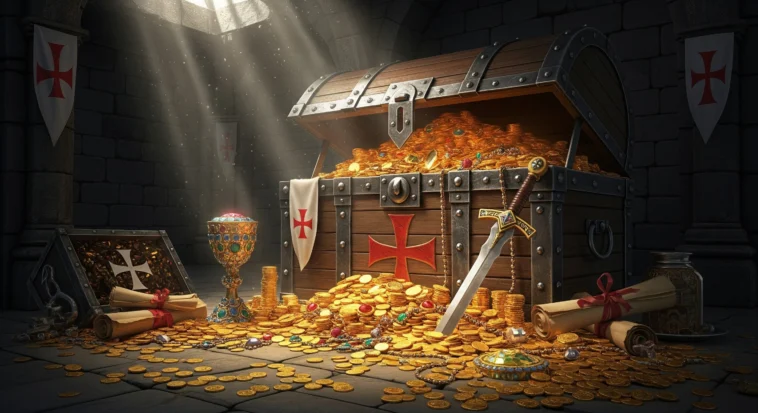
The legend of the Knights Templar’s lost treasure has fascinated people for hundreds of years — historians, treasure hunters, even movie directors.
Stories say this secretive order hid away mountains of gold before mysteriously vanishing.
But here’s the real question: was the treasure ever real, or just the world’s longest-running mystery story?
The Rise of the Knights Templar: From Humble Beginnings to Medieval Powerhouse
Back in 1119, these guys kick things off as what’s basically a glorified security squad for pilgrims in Jerusalem.
Not a big deal at first, but then boom—the Church gives them the golden ticket in 1129 at the Council of Troyes.
Suddenly they’re not just a bunch of bodyguards; they’re rolling in privileges from Pope Innocent II.
No taxes, only the Pope can boss them around, the whole nine yards. Nobles start throwing money and land at them left and right.
Castles, farms, churches—you name it, they’re snapping it up all over Europe.
Fast-forward a bit, and by the 1200s, they’re not just swinging swords anymore.
They’ve basically invented the medieval version of banking.
Like, you could drop off your cash in Paris, travel all the way to the Holy Land, and pick it up there.
Kinda like the original ATM network, just swap out the electronics for armored guys on horseback.
So yeah, these dudes end up half warrior, half banker—pretty wild combo for the Middle Ages.
The Templar Treasury: What Did They Actually Possess?
To figure out what the Knights Templar might have hidden, you first have to know what they actually owned — and trust me, it was a lot.
Land and Property Holdings
At their peak, the Templars owned around 870 castles, farms, and estates across Europe and the Middle East.
These places weren’t just fancy hangouts — they produced crops, collected rent, and brought in steady income.
Think of it as a medieval real-estate empire.
Financial Operations
These guys weren’t just warriors — they were early bankers.
They managed royal treasuries, lent money, and charged small fees that added up big time. King John of England even kept his crown jewels in their London headquarters.
Yeah, that’s how much people trusted them.
Religious Relics and Artifacts
As they had been given access to the Holy Land, it is conceivable that the Templars created holy artifacts — crosses, chalices, perhaps even objects said to be connected to the Bible.
In medieval society, those were more valuable than gold.
Liquid Assets
They also had piles of silver, gold, and jewels to fund their armies and massive building projects.
Historians say that, at their richest, the Templars controlled the medieval version of billions of dollars.
But here’s the twist — most of it wasn’t buried treasure. It was tied up in land, buildings, and influence, not just chests of gold waiting to be found.
The Fall: October 13, 1307
Here’s where things get wild — and dark. On Friday, October 13, 1307 (yep, that Friday the 13th), the Knights Templar’s world came crashing down.
King Philip IV of France, who owed them a ton of money, decided he’d had enough.
Instead of paying his debts, he accused the Templars of heresy, devil worship, and all sorts of made-up crimes — then ordered their mass arrest.
This moment is where the whole Templar treasure mystery kicks off.
Just before the arrests, people reported seeing wagons leaving the Paris Temple and ships sailing out of La Rochelle — supposedly loaded with something valuable.
Gold? Sacred relics? Secret documents? No one knows for sure, and that mystery has fueled centuries of treasure hunts.
The Templars’ last Grand Master, Jacques de Molay, was captured, tortured into confessing to lies, and burned at the stake in 1314.
The Pope later shut down the entire order in 1312, and while their property was supposed to go to another group called the Knights Hospitaller, most of it mysteriously “ended up” with kings — especially Philip.
And just like that, one of the most powerful organizations in medieval history vanished… but their legend was only getting started.
Theories About the Missing Treasure
So, what really occur to the Templar treasure? That’s the million-dollar question — and it’s kept historians, treasure hunters, and conspiracy fans hooked for centuries.
Here are the biggest hypothesis still floating around:
The Scotland Theory
There are those who think that the Templars fled to Scotland, where they found sanctuary offered by King Robert the Bruce (himself likewise excommunicated by the Pope).
There are even hints that they joined esoteric societies which in turn extended their influence into Freemasonry — itself, ironically, strongly rooted in Scotland.
The Oak Island Mystery
Off the coast of Nova Scotia, there’s a place called Oak Island — basically a treasure hunter’s dream.
For 200+ years, people have been digging there, convinced the Templars buried gold in the island’s “Money Pit.”
Tons of theories, zero proof, but the legend refuses to die.
Rennes-le-Château Connection
In a tiny French village, a priest suddenly got super rich in the late 1800s.
People went wild with rumors — maybe he found the lost Templar gold? Others say it was just shady bookkeeping, but the mystery made Rennes-le-Château a hotspot for treasure hunters.
Portugal and the Order of Christ
This one’s more grounded. In Portugal, the Templars weren’t exactly wiped out — they were rebranded.
King Dinis formed the Order of Christ to keep their work (and maybe their wealth) alive.
Fun fact: this order later helped fund Portugal’s great explorers — including the ones who sailed around the world.
Hidden in Plain Sight
And maybe, just maybe, there was never a hidden hoard at all.
Some historians think most of the Templar wealth was absorbed into royal treasuries, land deals, and the economy.
No secret vaults, no buried gold — just the slow disappearance of riches through time.
What Modern Research Reveals
Today’s historians and archaeologists aren’t exactly buying the “buried mountain of gold” story.
Sure, the Templars were rich — like, medieval-billionaire rich — but most experts say the idea of a massive secret treasure is probably more legend than reality.
When researchers dig up old Templar sites, they usually find cool stuff — like pottery, coins, weapons, or church relics — but nothing close to the mythical hoards people imagine.
It’s like expecting a dragon’s lair and finding a medieval bank office.
Historians also point out that the Templars’ money wasn’t just sitting in chests.
It ran an entire global operation — armies, castles, hospitals, and ships. So, hiding all that overnight? Pretty much impossible.
And here’s the kicker: records show that when King Philip IV of France shut down the order, he actually seized a lot of their assets — gold, silver, and religious items.
It didn’t make him as rich as he hoped, but it proves most of the treasure wasn’t lost. It was just taken, spent, or absorbed into history.
The Enduring Appeal of the Legend
Even though historians have pretty much debunked the idea of a hidden Templar fortune, the legend just won’t die — and honestly, it’s easy to see why.
For starters, the Templars vanished in such a mysterious way. T
heir ships disappeared, records went missing — it’s like the ultimate medieval cliffhanger.
Who wouldn’t start imagining treasure chests being smuggled away under cover of night?
Then there’s their image: warrior monks guarding holy secrets from the Crusades.
People love the idea that they might’ve hidden not just gold, but relics like the Holy Grail or even the Ark of the Covenant. That turns the story from a treasure hunt into a spiritual mystery.
And let’s be real — humans love a good mystery. Secret orders, lost riches, holy relics — it’s the perfect mix of adventure and “what if?” that keeps us hooked century after century.
Conclusion: Treasure Found in Understanding
The Templar treasure story is fun to chase, but the real payoff is what we learn about history.
Instead of a chest of gold, the Templars left us banks, battle stories, and power plays that shaped medieval Europe — stuff way more interesting than coins.
Think of it like digging for pirate loot and finding an old blueprint for how money and power worked; nerdy, but huge.
If you want treasure, study their story — it teaches you how institutions, religion, and politics actually made the world we live in.