
 Winton Eliott
Once you’ve heard the phrase “neoplasm of uncertain behavior,” you can completely freak out or be confused. Ponder it as a “maybe” tumor—it’s not obviously harmless, but it’s not obviously cancerous, either.
Physicians will tell you that when they don’t yet have enough leads to determine what’s happening.
The good news? With follow-up monitoring and tests, most frequently everything is fine. Visualize it as your cell phone having a “low battery” on the screen—you don’t panic, but you notice and refill it.
Knowing what’s occurring and what’s going to happen next can make you a lot more secure than guessing in the dark.
What Is a Neoplasm of Uncertain Behavior?
An abnormal growth or lump that occupies an unusual middle region is known as a neoplasm of uncertain behavior, but it’s not necessarily regarded as cancer or uncomplicated.
Imagine a medical puzzle where some pieces fit safely while others don’t; the doctor can’t confidently determine which piece fits first.? Why take this kind of picture? For that reason, they use this term.
According to medical science, the cells exhibit non-normal but still prognostic factors such as abnormal characteristics or genetic indications.
So the next step is getting more info — extra tests, maybe another sample, and careful follow-up.
It’s like a detective coming back with better tools or re-interviewing witnesses: the team wants to know if this thing could spread or act aggressive, and they won’t guess.
The Diagnostic Process: How Uncertain Behavior Is Determined
When a doctor mentions something like a “neoplasm of uncertain behavior,” they’re basically admitting, “Look, even the microscope isn’t giving us the full story yet.”
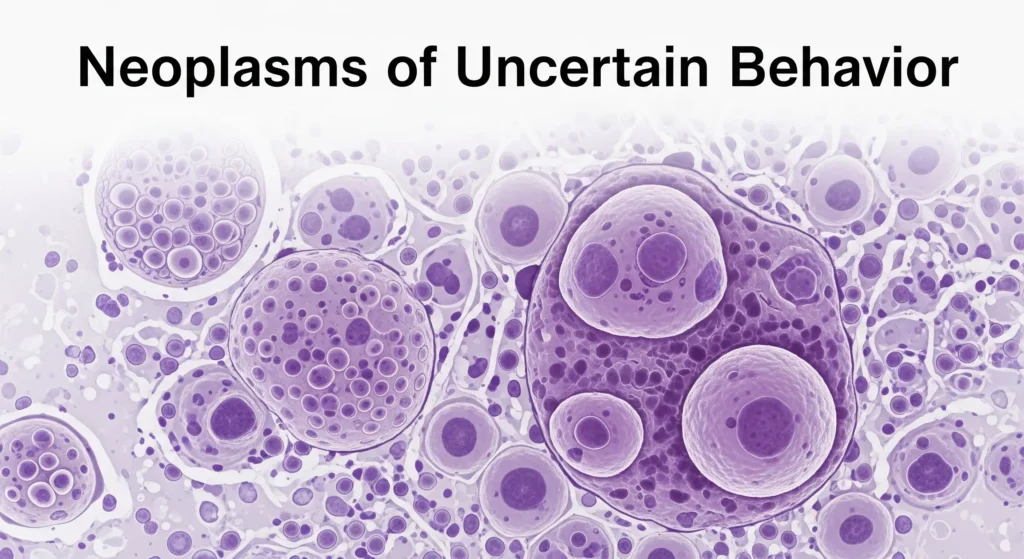
Pathologists—think of them as tissue detectives—are peering through slides, trying to piece together evidence.
Key Factors in Diagnosis
Cellular Appearance
Pathologists check the size, shape, and order of the cells. If cells look a bit odd but don’t hit the “this-is-cancer” checklist, the result can be “uncertain.”
Picture opening a birthday present that’s wrapped like a toy but feels heavy — you need to unwrap it to know.
Growth Patterns
How the cells are arranged and how they touch nearby tissue matters a lot. It’s like watching how players move on a team — the pattern tells you if they’re playing safe or playing rough.
Molecular Markers
These are tiny biological flags — proteins or genes — that modern tests can find. They’re like secret codes: some codes strongly suggest danger, others don’t, and sometimes the code is incomplete.
Clinical Context
Where the growth is, what symptoms you have, and your medical history all change how those microscope clues are read. A mole on your arm and a lump deep in your belly aren’t treated the same way — context matters.
Common Types and Locations
Neoplasms with uncertain behavior can manifest in almost every part of the body, but certain areas are more susceptible to infection than others.
Consider the concept of hidden locations in a video game, where certain areas are more difficult to penetrate than others.?
Skin Neoplasms
The skin is one of the most common places for these “maybe” growths. They might show up as weird moles, stubborn bumps, or cuts that just won’t heal.
Dermatologists see lots of growths that don’t fit neatly into “harmless” or “cancer,” like a puzzle piece that almost fits but not quite.
Brain and Central Nervous System
Growths in the brain or spinal cord are extra tricky because these organs are super important and hard to sample.
Some brain tumors act like riddles — they have hints of danger, but you can’t be sure without advanced scans or even more than one biopsy.
Connective and Soft Tissues
Muscles, tendons, and other soft tissues can also host these uncertain growths.
Sometimes the cells behave in ways that confuse doctors — it’s like watching a dance where some moves make sense and others throw you off completely.
Internal Organs
Organs inside your body — the stomach, reproductive organs, or glands — can develop growths that doctors can’t immediately classify.
Each location has its own “rules of the game” for figuring out if the growth is harmless or potentially aggressive.
The Medical Classification System
ICD-10 is a system that doctors and hospitals use to track medical conditions, including those that include unanticipated behavior or diseases.
Consider it as a comprehensive filing system or colosses library catalog, with each type of growth having its own “box” or code.
There are currently 69 various codes in total for these enigmatic growths, depending upon where they appear and what they are.
That is a great many choices! It makes it clear how difficult such diagnoses can be and why physicians must explain themselves to one another.
These codes are not “placeholders” until test results are received.
They are reserved only if physicians have performed all the tests that can be done, but the growth still can’t be rightly said to be malignant or benign.
It is writing, “We’ve done our best to solve the enigma — now we wait, watch, and prepare.”.
Treatment Approaches and Management Strategies
The treatment of neoplasms with uncertain behavior typically involves a conservative but vigilant approach.
Since these growths exist in a diagnostic gray area, treatment plans must balance the potential risks of under-treatment with the risks of over-treatment.
Active Surveillance
Many cases of uncertain behavior neoplasms are managed through active surveillance, also known as “watchful waiting.” This approach involves:
- Regular follow-up appointments with your healthcare provider
- Periodic imaging studies to monitor for changes in size or appearance
- Additional biopsies if the growth shows concerning changes
- Patient education about warning signs to watch for
Surgical Removal
In some cases, complete surgical removal of the growth may be recommended, particularly when:
- The location allows for safe, complete removal
- The uncertain behavior diagnosis causes significant patient anxiety
- The growth is in a location where monitoring is difficult
- There are concerning changes in the growth over time
Multidisciplinary Care
Complex cases often benefit from input from multiple specialists. A team approach might include oncologists, pathologists, surgeons, and other specialists relevant to the specific location and characteristics of the growth.
Living with an Uncertain Behavior Diagnosis
When it comes to neoplasms of uncertain behavior, doctors usually take a careful but watchful approach.
Since these growths live in the “maybe” zone — not clearly harmless, not clearly cancer — the goal is to avoid overreacting but also not missing anything important.
Active Surveillance
Many of these growths are managed with active surveillance, or “watchful waiting.” That means:
- Regular check-ins with your doctor
- Periodic scans to see if the growth changes
- Extra biopsies if something starts acting suspicious
- Learning what warning signs to look for
It’s like keeping an eye on a new character in a game — you don’t attack immediately, but you stay alert and ready to act if things change.
Surgical Removal
Sometimes, doctors recommend surgery to take the growth out completely. This usually happens when:
- The growth is in a place that can be safely removed
- The uncertainty is stressing the patient out
- Monitoring would be tricky or unreliable
- The growth starts showing concerning changes
Imagine cutting out a glitchy piece of software rather than risking it messing up the whole system — surgery can do that.
Multidisciplinary Care
More complex cases, physicians will bring on board a team of specialists — oncologists, pathologists, surgeons, etc. — to cover all their angles.
It’s like recruiting an expert team for a complex mission: each brings his or her special talent to crack the mystery successfully and intelligently.
The Future of Diagnosis and Treatment
Medicine is getting smarter every year, and that’s great news for those “maybe” growths.
New tools — like molecular tests, AI that reads patterns, and precision medicine that targets specific cell quirks — are like upgrading from a flip phone to a smartphone: suddenly you see details you couldn’t before.
Genetic testing and molecular profiling are getting sharp enough to spot clues that a microscope might miss, which could turn a “we don’t know” into a clear answer or a treatment that hits the problem exactly where it hurts.
That doesn’t mean overnight fixes, but it does mean more hope and better options as research moves forward.
Prevention and Risk Reduction
You can’t block all neoplasms, but some lifestyle habits tip the scale in your favor. Take these as basic life-balancing moves:
- Consume a healthy diet rich in fruits and vegetables.
- Engage in regular exercise to maintain your body and immune system strong.
- Avoid known carcinogens like tobacco and heavy alcohol consumption.
- Apply sunscreen — it’s not just for the beach.
- Be current on screening tests for your age and risk factors that are suggested.
Small actions accumulate. They’re not promises, but they’re rational means of providing your body with a little extra protection while science continues to refine its tools.
Conclusion
Getting a diagnosis of a neoplasm with uncertain behavior can feel scary, but it’s something doctors know how to manage.
Think of it like a tricky level in a game — you can’t rush it, but with careful moves, you can handle it. This label exists so your care is smart and evidence-based, not just guesswork.
How should I handle it? Contact your doctor, have all recommended medical checks and learn how to handle the stress of uncertainty.
The scientific community is constantly improving its tools for achieving more precise diagnoses and treatments.’