 Winton Eliott
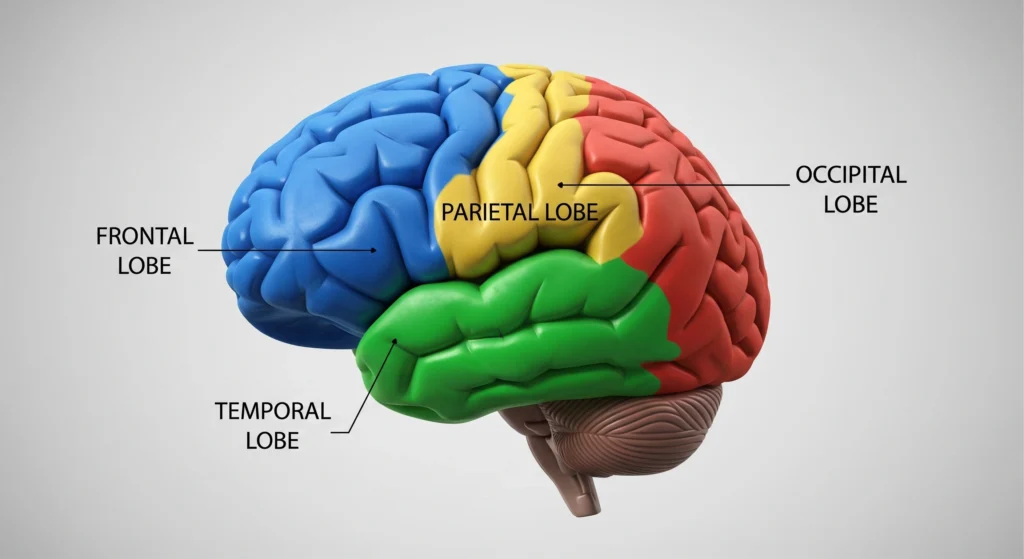
Think of your brain as the ultimate control center, and the cerebral cortex as its command deck split into four lobes, each doing a different, amazing job.
I’m excited to tell you: these lobes shape how you move, feel, learn, and make sense of everything around you — like how the frontal lobe helps you plan that perfect prank, the temporal lobe holds the soundtrack of your memories, the parietal lobe maps out where your body is during a skateboard trick, and the occipital lobe turns light into the movies you see.
The Four Cerebral Lobes: Your Brain’s Command Centers
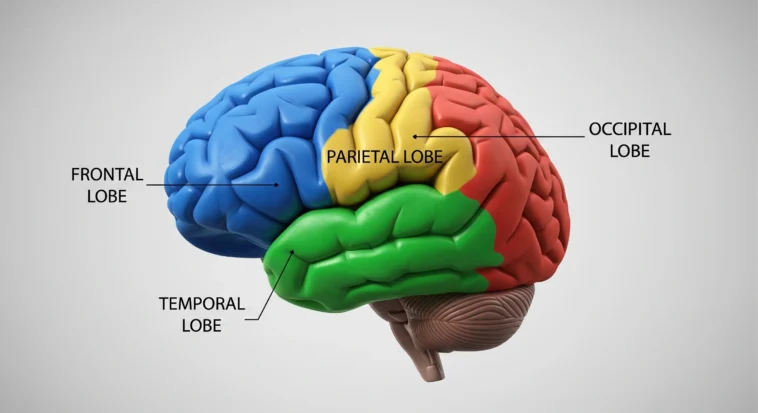
Your brain’s cortex is split into four lobes: frontal, parietal, occipital, and temporal.
Think of them like a squad, each with their own role, but together they run the whole show of “you.”
Frontal Lobe
Think of your frontal lobe as your brain’s CEO — the boss behind everything you do. It sits right behind your forehead and is a big part of what makes you… well, you.
Key Functions of the Frontal Lobe
- Executive Function & Decision Making Ever debate pizza vs. salad or figure out how to ace a tricky level in a game? That’s your frontal lobe running the show.
- Motor Control From dribbling a basketball to strumming guitar strings, the motor cortex sends signals to your muscles so you can move with purpose.
- Language Production Broca’s area in your left frontal lobe turns thoughts into words — without it, “I’m hungry” would just stay floating in your head.
- Personality & Social Behavior Your humor, morals, vibe, and the ability to not embarrass yourself in public. Damage here can seriously shake up someone’s personality.
Signs of Frontal Lobe Issues
If this lobe gets hurt, people might:
- Struggle to plan or organize even simple stuff
- Make questionable choices
- Act out of character socially
- Lose focus fast
- Have trouble controlling emotions or impulses
Parietal Lobe
Tucked between the front and back of your brain, the parietal lobe is like your built-in control tower for touch, space, and even math.
It’s the reason you know the sun feels warm on your skin, you can tell denim from silk just by touch, and you don’t bump into walls while walking with your phone out.
Primary Functions of the Parietal Lobe
- Touch and Sensory Processing Think of it as your brain’s “feel decoder.” Whether it’s the sting of a paper cut or the buzz of your phone in your pocket.
- Spatial Awareness Ever nailed a basketball shot without looking at your hands? That’s this lobe knowing where your body is in space and guiding you.
- Number Processing and Math Thinking Crazy enough, your math skills live here too — from counting money at the store to solving equations in class.
- Language Comprehension It also helps you make sense of directions like “turn left after the red house,” connecting words to space.
Parietal Lobe Dysfunction Symptoms
When this lobe struggles, life feels confusing: objects feel unfamiliar by touch, math gets harder, navigation feels like being lost in your own neighborhood, and even reading or writing can trip you up.
Temporal Lobe
Sitting right by your temples, the temporal lobe is where sound meets memory.
It’s why you can recognize your best friend’s voice in a crowded room, hum along to your favorite song, and remember what you studied last night (hopefully).
Core Functions of the Temporal Lobe
- Auditory Processing Imagine a concert in your head — this lobe’s “sound booth” sorts every note, voice, and noise you hear.
- Memory Formation and Retrieval Thanks to the hippocampus here, you can stash away new memories and pull out old ones.
- Language Comprehension Wernicke’s area makes sure you don’t hear words as random gibberish — it connects meaning so sentences actually click.
- Emotional Processing With the amygdala in the mix, this lobe helps decide if something makes you laugh, cry, or panic when you hear a sudden loud bang.
Temporal Lobe Problems
When things go wrong here, you might struggle to follow conversations, forget what just happened, lose track of words, or feel emotions spiraling out of control.
In some cases, it can even trigger seizures.
Occipital Lobe
Tucked at the very back of your head, the occipital lobe may be the smallest lobe, but it’s basically your built-in HD screen.
Without it, the world would be a blur — no sunsets, no faces, no memes.
Essential Functions of the Occipital Lobe
- Visual Processing This is where raw light signals turn into the scenes you actually see — from recognizing your best friend’s face to spotting your phone across the room.
- Color Recognition Ever argued if something’s blue or green? This lobe settles it by decoding colors.
- Motion Detection That quick reflex when you dodge a soccer ball flying at you? Yep, thank your occipital lobe.
- Depth Perception It fuses what both eyes see so you can catch a ball, pour water into a glass, or not trip over a curb.
Occipital Lobe Impairment
If this lobe gets damaged, vision can fade or warp — colors look off, faces seem unfamiliar, depth disappears, or sometimes the brain even “invents” images with hallucinations.
How the Lobes Work Together
Your brain isn’t a bunch of lonely roommates living in separate rooms — it’s more like a group chat where everyone’s constantly talking and sharing info.
The lobes don’t work in isolation; they’re wired together through millions of connections, teaming up for everything you do.
Take reading this right now: your occipital lobe is acting like a camera, turning letters into images.
Your temporal lobe jumps in to make sense of those words so they’re not just squiggles.
Your parietal lobe keeps track of where the words are on the page (so you don’t lose your place).
And your frontal lobe? That’s the strategist, helping you analyze what it all means — kind of like piecing together clues in a mystery.
Maintaining Brain Health Across All Lobes
The significance of each lobe and their roles makes it clear why it is important to focus on the entire brain.
These habits, which are backed by evidence, can help you maintain optimal brain performance:
Physical Exercise
Move your body — seriously.
Exercise boosts blood flow, helps new neural connections grow, and gives every lobe more fuel to work with.
Think of it like oiling the gears: a 20–30 minute jog or a quick skate session before studying can make your focus and mood much better.
Mental Stimulation
Challenge your brain often.
Learning guitar chords, cracking logic puzzles, or picking up a new language keeps circuits flexible across the lobes.
Quality Sleep
Sleep isn’t lazy time — it’s when your brain files memories and clears out waste.
Pulling an all-nighter? Your hippocampus (memory hub) will hate you. Try to make sleep a priority, especially after big study sessions.
Social Engagement
Talking, joking, and even arguing with friends lights up lots of brain regions at once — especially the frontal and temporal lobes that handle social thinking and emotions.
A night out or a deep chat can be as good for your brain as a study group.
Balanced Nutrition
Food counts. Foods rich in omega-3s (fish or walnuts), antioxidants (berries or greens), and whole nutrients nourish your brain and guard against cell damage.
Consider food as the brain toolbox — select the building blocks that construct and rebuild.
Modern Research and Future Directions
Neuroscience is moving fast — like, sci-fi fast. Projects such as the BRAIN Initiative® (which just hit its 10-year mark in 2024) are giving us crazy new insights into how the lobes of your brain actually team up.
Think of it like scientists finally getting a backstage pass to watch the band instead of just hearing the music.
This research isn’t just for curiosity — it’s paving the way for real breakthroughs.
We’re talking smarter treatments for brain disorders, new tech to help people regain lost abilities, and even ways to fine-tune brain health so you can focus better, learn faster, and maybe one day plug into tools we can’t even imagine yet.
The future of brain science? It’s like we’re only on chapter one of the coolest book ever written — and the next chapters will blow our minds (literally).
Conclusion: Appreciating Your Brain’s Complexity
Your four lobes — frontal, parietal, temporal, and occipital — each have their own special something, but only glitter when they’re all joined together like a well-rehearsed stunt team pulling off a flawless stunt.
From scheming out your day (frontal) to sensing a zephyr on your skin (parietal), recalling a joke (temporal), or taking in a sunset (occipital), all experience is collaboration.
Having a sense of what each lobe does makes it easier to look after your brain — day-to-day choices such as sleep, movement, and learning actually do make a difference — and makes the whole process not enigmatic anymore but something like the most awesome, most complex machine you have.