 Winton Eliott
The difference between financial success and struggle usually isn’t about how much cash you have—it’s about what’s happening in your head.
A lot of people think wealth comes from income, luck, or family, but research shows your mindset shapes the choices that build (or break) wealth and happiness.
Think of your brain as your operating system: upgrade the settings, and the rest runs smoother.
Understanding the distinction isn’t about judging someone’s wallet. It’s about spotting the habits and beliefs that move people forward or hold them back.
That’s the real difference—thought patterns, not bank balances.
Understanding the Mindset Paradigm
Psychologist Carol Dweck taught us a huge lesson: how you view your ability to grow changes everything.
If you believe you can improve, you try, fail, learn, and try again. If you think you’re stuck, you quit early. It’s like choosing between “I’ll learn from this” and “I’m just not cut out for it.”
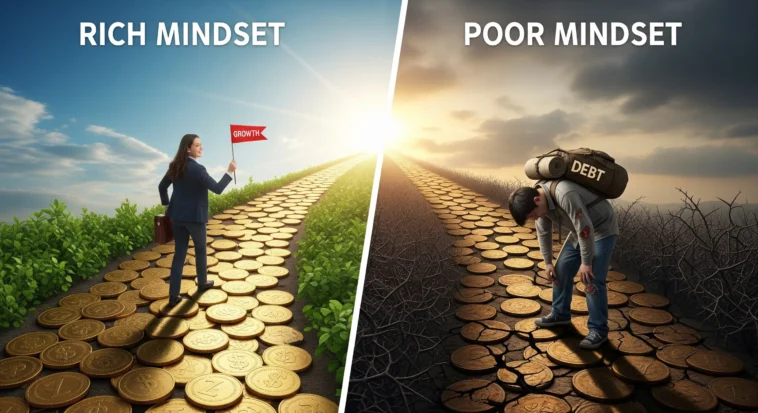
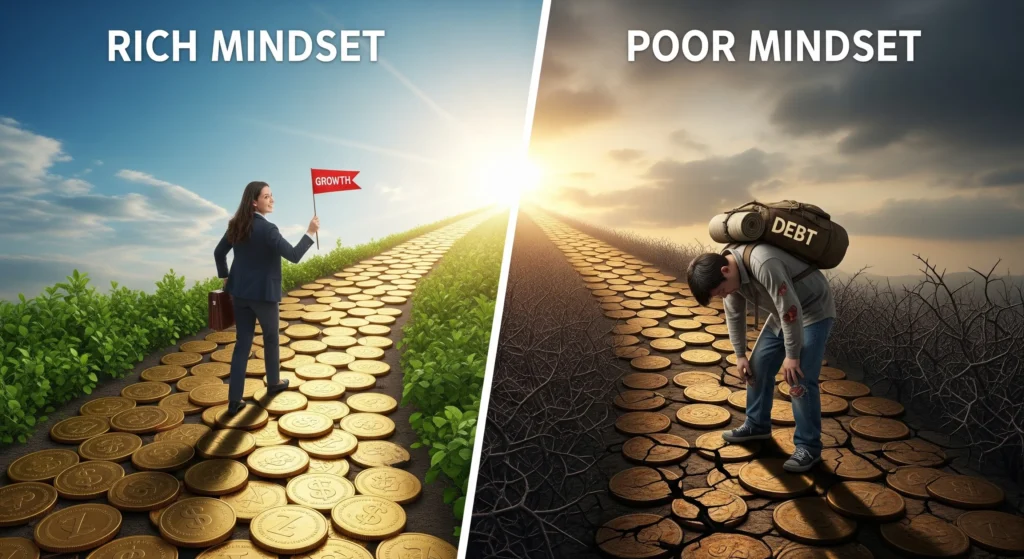
A “rich” mindset isn’t about daydreaming of fancy cars nonstop. It’s a way of seeing possibilities—taking responsibility, learning from mistakes, and betting on your future.
A “poor” mindset lives in scarcity: blaming luck, avoiding risks, and staying small.
The scary part? Either mindset shapes your choices—how you spend time, where you put money, and whether you even try. Choose the one that lets you grow. Trust me: your future self will thank you.
Abundance vs Scarcity Thinking
One of the biggest differences between a rich mindset and a poor mindset is how you see the pie.
The Rich Mindset
Thinks the pie can get bigger. More opportunities. More ideas. More wins. If your friend succeeds, that doesn’t steal your future — it proves success is possible.
People with this mindset clap for others, learn from them, and build connections. They don’t panic when someone else shines. They think, “Cool. What can I learn from that?”
The Poor Mindset
Thinks the pie is tiny and someone just took your slice. If someone wins, you lose. That’s the vibe. So people get jealous, guarded, and scared to share ideas.
But here’s the twist: that defensive energy actually blocks opportunities. When you act like there’s not enough, you stop seeing what is available.
Positive psychology research even shows that people who practice gratitude and notice what they already have tend to make smarter money decisions and feel happier overall.
Gratitude isn’t cheesy — it sharpens your focus.
Learning Investment vs Cost Avoidance
Here’s another big one: how you see learning.
The Rich Mindset
Sees learning like planting seeds. Books, courses, mentors — they’re investments. You spend a little now so you can earn a lot later. It’s like leveling up your character in a game.
The more skills you build, the more opportunities unlock. Even psychologist Carol Dweck talks about how believing you can grow changes your results. Growth compounds.
The Poor Mindset
Sees learning as “ugh, that’s expensive.” Now, being smart with money is good. But refusing to invest in yourself? That’s like refusing to buy better tools and then wondering why building is hard.
Skipping a course that teaches you a valuable skill might save money today — but it could cost you way more tomorrow.
Research from the Pew Research Center shows people with higher education levels tend to earn more over their lifetime. That’s not magic. That’s investment paying off.
Problem Solving vs Problem Dwelling
When life punches you in the face (and it will), your mindset decides what happens next.
The Rich Mindset
Asks, “Okay… how do I fix this?” or even better, “How can this help me grow?” Obstacles aren’t stop signs — they’re puzzles. People with this mindset get creative. They adapt. They move. Even when things suck, they stay in motion.
The Poor Mindset
Gets stuck replaying the problem. “Why me?” “This isn’t fair.” “It’s their fault.” And sure, sometimes it is unfair. But sitting there doesn’t change anything.
That victim mode drains your energy and keeps you frozen.
Research in cognitive behavioral therapy shows something powerful: your thoughts shape your emotions, and your emotions shape your actions.
Change the way you think about a problem, and suddenly you can actually do something about it.
Long-Term Vision vs Short-Term Gratification
This one’s huge. It’s the difference between building a future… and buying snacks you don’t even remember eating.
The Rich Mindset
Think long-term. They’re willing to skip today’s tiny pleasure for tomorrow’s bigger reward.
They save. They invest. They build skills. They understand that real success compounds over time — like stacking small wins that turn into big results.
Psychologist Walter Mischel proved this in the famous marshmallow experiment.
Kids who could wait for two marshmallows instead of grabbing one immediately ended up with better life outcomes later on. That ability to wait? It matters. A lot.
The Poor Mindset
I want it now. Impulse buys. Easy comfort. Quick dopamine hits. And hey — enjoying life is important.
But if you always choose now over later, you end up broke, stressed, and wondering what happened.
Taking Responsibility vs Blaming Circumstances
This one might be the biggest game-changer of all.
The Rich Mindset
Says, “Okay… what can I do about this?” Even when life isn’t fair. Even when the situation sucks. They understand they can’t control everything — but they can control their reaction.
So when they mess up, they don’t hide. They ask, “What can I learn? How do I improve?” That’s power.
The Poor Mindset
Points fingers. The economy. The government. Their boss. Their parents. Bad luck. And yes — those things matter. Life isn’t equal. But if you focus only on what you can’t control, you hand over your power.
Psychologists call this “locus of control.” People with an internal one — who believe their actions matter — consistently achieve more and feel happier than those who believe everything is controlled by outside forces. Your choices count more than you think.
Multiple Income Streams vs Single Source Dependency
Let’s talk money strategy.
The Rich Mindset
Doesn’t put all its eggs in one basket. They build multiple income streams — investing, side hustles, assets. They understand one paycheck = one point of failure.
IRS research even shows most millionaires have several sources of income — often around seven. That’s not luck. That’s design.
The Poor Mindset
Relies on one paycheck and hopes nothing goes wrong. A job can be great. But if it’s your only plan, you’re vulnerable. One layoff, one crisis, and everything shakes.
Calculated Risk Taking vs Risk Avoidance
Here’s the truth: you can’t grow if you never step outside your comfort zone.
The Rich Mindset
Takes smart risks. Not crazy, YOLO, “bet everything on crypto” risks. Calculated ones. They research. They think. Then they move. They know failure isn’t the end — it’s feedback.
It’s like leveling up in a game. You lose a round, you learn the pattern, you come back stronger.
The Poor Mindset
Either avoids all risk (“What if I fail?”) or takes reckless risks without thinking. Both are dangerous. Playing too safe keeps you stuck. Gambling without knowledge burns you. The sweet spot? Courage + preparation.
Business research keeps showing the same thing: growth requires thoughtful risk. Not paralysis. Not recklessness. Thoughtful action.
Relationship Building vs Transactional Interactions
This one might surprise you.
The Rich Mindset
Understands that relationships are assets. They build real connections. They help people without instantly asking, “What do I get?” They know opportunities usually come through people.
Even research from Harvard Business Review shows strong networks boost career success. Your network often shapes your net worth.
The Poor Mindset
Treats people like vending machines. “What can you give me?” That energy pushes people away. And when tough times hit? There’s no real support system.
Practical Steps to Develop a Rich Mindset
Alright. Knowing this stuff is cool. But knowing without doing? That’s just trivia. If you actually want to build a powerful mindset, here’s how you start — right now, at 15.
Practice Gratitude Daily
Yeah, I know. Sounds cheesy. But it works.
Research shows gratitude literally trains your brain to see opportunity instead of lack. Take five minutes every morning.
Write down three things you’re grateful for. Your health. Your Wi-Fi. That one friend who always has your back. Train your brain to notice what’s working.
Invest in Continuous Learning
Your brain is your biggest asset. Treat it like one. Read books. Take online courses. Watch interviews with people who’ve built things.
If you get money — even a little — spend some of it upgrading yourself. Skills compound. Knowledge stacks. You’re building future income every time you learn something useful.
Surround Yourself With Growth-Oriented People
Energy is contagious. If you hang around people who complain all day, you’ll start complaining. If you hang around people who build, think big, and take action, you’ll level up faster.
Choose your circle carefully. It shapes you more than you realize.
Reframe Failures as Learning Opportunities
You will mess up. That’s guaranteed. But don’t turn one mistake into a life sentence.
Instead of saying, “I’m bad at this,” ask, “What did this teach me?” Every successful person you admire has a graveyard of failed attempts behind them. They just didn’t quit.
Set Long-Term Goals and Create Systems to Achieve Them
Dream big. Then zoom in. Break your goals into small daily actions. Want to be financially independent? Start by learning about money 10 minutes a day.
Big results come from small habits repeated consistently. It’s boring sometimes — but boring wins.
Challenge Scarcity Thoughts
When your brain says, “I can’t afford that” or “There’s not enough,” pause. Flip it. Ask, “How could I make this possible?” That tiny shift turns your brain into a problem-solving machine instead of a complaining machine.
Take Responsibility for Your Outcomes
This is your power move. When something goes wrong, don’t waste time blaming. Ask, “What can I control here?” Even if it’s small. Action creates confidence. Confidence creates momentum. Momentum changes your life.
Conclusion
At the end of the day, the difference between a rich mindset and a poor mindset isn’t about your wallet — it’s about how you see the world. Do you see doors… or walls? Do you ask, “What can I do?” or “Why is this happening to me?” Your mindset decides whether you stay stuck or start building.
This isn’t about pretending life is easy. It’s not. Obstacles are real. But mindset determines whether you shrink from them or grow through them.
A rich mindset fuels action. It pushes you to learn, take smart risks, spot opportunities, and keep improving — even when things don’t go your way.
And here’s the best part: your mindset isn’t permanent. It’s not tattooed on your brain. You can change it. With practice. With awareness. With small daily choices.