 Winton Eliott
Have you ever felt like there’s never enough—not enough time, money, chances, or spotlight? Or seen someone win and thought, “Ugh, why not me?”.
That feeling isn’t just jealousy or stress. It’s often a scarcity mindset, and yeah—it can quietly mess with your confidence, choices, and future.
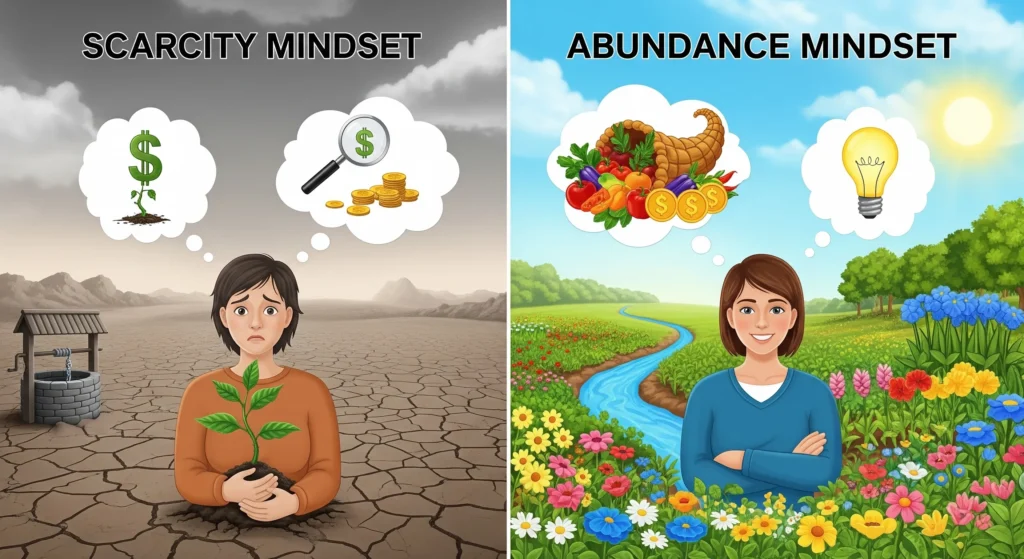
The difference between scarcity and abundance isn’t fluffy self-help talk. It’s basically how your brain decides whether life is a fight over crumbs… or a table with room for everyone.
And that choice shapes your friendships, goals, and happiness more than you think.
What Is a Scarcity Mindset?
A scarcity mindset is the belief that there’s only so much to go around. If someone else wins, you lose. Simple as that. Stephen Covey talked about this idea years ago, but modern science backs it up too.
Research shows that when people feel scarcity, their brains go into survival mode—like your phone stuck on low battery. You can still function, but not at your best.
Scarcity isn’t just about money. It’s about time (“I’m always behind”), love (“What if I’m not enough?”), and success (“There’s no space for me”). It makes life feel like one long panic scroll.
Common Characteristics of Scarcity Mindset
People stuck in scarcity often:
- Hoard stuff, secrets, or credit like squirrels before winter
- Feel annoyed or threatened when others succeed
- Overthink every decision because they’re scared of messing up
- Focus on quick wins instead of big dreams
- Compete instead of teaming up
- Compare themselves nonstop and feel “less than”
- Avoid risks, even good ones
Here’s the plot twist: believing there’s “not enough” actually creates less. It pushes people away, shrinks opportunities, and keeps you stuck. The mindset becomes the cage.
What Is an Abundance Mindset?
An abundance mindset is the belief that life isn’t a tiny pizza with eight slices, it’s a kitchen where you can make more food. Someone else winning doesn’t steal your chance.
It just proves winning is possible. This doesn’t mean ignoring reality; it means believing you can create opportunities instead of fighting over leftovers.
Psychologist Carol Dweck found something similar with her growth mindset research: people who believe they can grow smarter actually do.
Same idea here. Abundance thinkers trust that effort, creativity, and teamwork can grow the pie.
Key Features of Abundance Mindset
People with abundance thinking usually:
- Share ideas and help others without freaking out
- Celebrate wins instead of feeling jealous
- Think long-term, not just “right now”
- Team up instead of trying to beat everyone
- Stay curious and open to new ideas
- Practice gratitude (yes, even for small stuff)
- Take smart risks and learn from mistakes
These people tend to be more confident, creative, and better at friendships—and yeah, more successful too.
The Science Behind the Mindsets
Your brain actually reacts differently depending on how you think. Scarcity mode puts your brain in panic mode —like before a test you didn’t study for. You get stressed and stop thinking clearly.
Abundance mode does the opposite. Gratitude and optimism boost “feel-good” chemicals like dopamine, helping your brain think bigger and smarter.
Studies even show that leaders who think this way build better teams and get better results.
Real-World Impact: How Your Mindset Shapes Your Reality
In Your Career
Your mindset is basically your career’s steering wheel.
When people think in scarcity mode, they:
- Hide info like it’s a secret cheat code
- Treat promotions like a battle royale
- Avoid helping others because “what if they replace me?”
- Feel like a fraud who has to be perfect all the time
Abundance thinkers do the opposite:
- Share what they know and become that reliable person
- Help others win, knowing it helps them too
- Mentor people and grow into real leaders
- Say “I’ll figure it out” instead of “I’m not ready”
Fun fact: Psychologist Adam Grant found that givers—people who help without hoarding—end up more successful long-term than selfish “takers.”
In Relationships
Scarcity thinking turns relationships into stress factories:
- Jealousy, possessiveness, and trust issues
- Keeping score like, “I did this, you owe me”
- Secretly resenting other people’s success
Abundance thinking makes relationships feel lighter:
- You’re genuinely happy when others win
- Trust comes easier, so connections go deeper
- You give without expecting instant payback
- You know love and friendship don’t “run out”
In Financial Decisions
Here’s the irony: worrying about money too much often makes money decisions worse. Scarcity thinking leads to:
- Short-term choices that hurt long-term goals
- Fear of smart risks
- Missing chances to grow
- Stress spending to feel better
Abundance thinking looks like:
- Planning for the long game
- Investing in skills and learning
- Taking smart, researched risks
- Giving generously, because you believe more will come
How to Shift from Scarcity to Abundance
Here’s the good news: your mindset isn’t stuck. Your brain is more like a playlist—you can change the track. With practice, you can train it to think in abundance.
Practice Gratitude Daily
Gratitude is like a mental gym workout. Every day, name three specific things you’re thankful for. Not “my friends,” but “that joke my friend told that made me laugh way too loud.” Specific = powerful.
Reframe Competition as Collaboration
When jealousy pops up, pause and ask: “How could we both win here?” Life isn’t a Hunger Games arena. Sometimes teaming up—or just cheering someone on—actually opens doors for you too.
Share Generously
Share ideas. Help people. Make introductions. Don’t keep score like it’s a video game. Giving reminds your brain that you’re not running out—you’re overflowing.
Limit Comparison and Curate Your Inputs
Social media is a comparison trap. If someone’s posts make you feel small, unfollow. If they make you think bigger, keep them. Remember: you’re seeing highlight reels, not real life.
Invest in Personal Growth
Abundance thinkers see themselves as “under construction”. Learn new skills. Read. Ask for help. Your potential isn’t capped unless you decide it is.
Challenge Scarcity Thoughts
When your brain says, “What if I fail?” talk back. Ask: “Is this fact or fear?” Then imagine what the abundance version of you would do.
Abundance Mindset in Leadership and Business
If you ever want to lead a team—or start something big—this part matters a lot. Leaders with an abundance mindset don’t run their teams like a last slice of pizza. They build places where:
- People feel safe trying new ideas
- Talent is grown, not guarded
- Teams actually work together
- Wins are shared, not stolen
- Decisions focus on the long game
Big companies like Google and Patagonia do this on purpose. They invest in people and ideas even when it doesn’t pay off instantly—and that’s exactly why they win long-term.
The Path Forward
Switching from scarcity to abundance isn’t a one-time glow-up. Some days your brain will go back to panic mode. That’s normal. You’re human, not a robot.
The goal isn’t to delete scarcity forever. Sometimes limits are real. The goal is to make abundance your default setting—how you usually see the world.
When you do, stuff changes. Relationships feel deeper. Opportunities show up more often. Problems stop feeling like threats and start feeling like puzzles.
Abundance isn’t fake positivity. It’s choosing openness, generosity, and confidence—even when things aren’t perfect.